















Sensory stimulation and psychomotor development in babies: an age-by-age guide
What sensory stimulation and psychomotor development mean, how they support your baby’s development and which simple activities you can offer from 0 to 12 months without rushing them.
Baby development
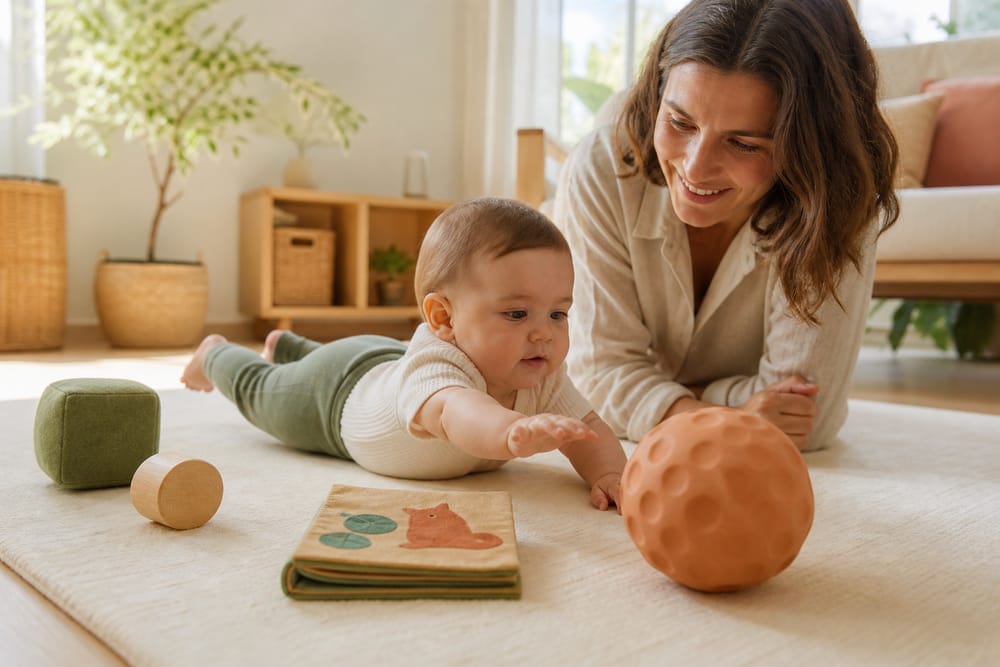
During the first year, almost everything is new: a voice coming closer, a piece of fabric brushing their hand, the feel of their body as they roll or a ball moving away. Babies learn by looking, listening, touching, moving and discovering what their own actions can make happen.
Supporting that process does not mean filling the day with exercises or buying special materials. Offer a safe space, stay close and notice what catches your baby’s interest. Stimulation should follow your baby’s pace rather than rush development.
This guide brings together play ideas for babies from birth to 12 months, ways to encourage free movement and signs that tell you when to continue or take a break. Ages are only a guide.
What do sensory stimulation and psychomotor development mean?
Sensory stimulation brings together experiences that help a baby take in and organise information through sight, hearing, touch, smell, taste, balance and awareness of their own body. It does not depend on toys with lights or special textures: bath water and changes of position count too. Your face and voice are part of these experiences as well.
Psychomotor development connects movement, perception, emotions and learning. During the first year, you can see it in everyday actions such as holding the head up, bringing the hands together, reaching for an object, rolling, sitting or moving around. Gross motor skills involve larger muscle groups; fine motor skills show up in precise actions such as grasping, releasing or passing an object from one hand to the other.
How do they support development in everyday life?
Play and communication create opportunities to practise motor, cognitive, language and social skills. The World Health Organization recommends combining responsive care with early learning opportunities during the first three years: noticing a child’s signals, responding to them and sharing activities suited to their stage of development.
The aim is to give your baby room to explore, repeat actions, rest and try again at their own pace. What matters is the quality of the interaction and that your baby feels safe while taking part.
Five principles before preparing any activity
An activity may be fascinating one day and too much the next. Hunger, tiredness, noise at home or a period of rapid development can change your baby’s desire to play. These principles help you adapt the activity to the moment.
- Choose a time when your baby is awake and comfortable: they should be settled and not hungry. After a large feed, wait until your baby is comfortable before offering tummy time.
- Keep stimulation simple: one voice, one object or one texture can be enough. Several lights, sounds and movements at once make it harder to tell what interests or bothers your baby.
- Follow your baby’s lead: if they look, touch or repeat an action, give them time. You do not need to keep switching activities. Repeating is part of learning.
- Do not place your baby in positions they cannot get into on their own yet: offer the activity on the floor and let them initiate reaching, rolling or moving themselves. Helping does not mean pulling their arms or propping them up in sitting or standing positions to practise.
- Finish before your baby gets tired: a few enjoyable minutes are better than carrying on once your baby starts protesting.
0 to 3 months: voices, faces, touch and gentle changes of position
In the first few weeks, you are your baby’s main source of stimulation. Newborns begin to recognise voices and faces, respond to touch and make small movements with their head, arms and legs. Keep activities brief and simple.
- Face-to-face time and talking: move close enough for your baby to see your face clearly, speak slowly and leave pauses as if you were waiting for a reply. Respond to their gestures and sounds as if they are taking a turn in the conversation.
- Visual contrasts: show a black-and-white card or a clearly outlined object and move it slowly through their field of vision. Stop if they look away.
- Everyday textures: let your baby touch your skin, a muslin cloth or a soft, clean fabric. Gently brush each material across their palm without rubbing or insisting if they pull their hand away.
- Soft sounds from one side: speak or gently shake a quiet rattle to one side, wait and change position slowly. Never make loud sounds close to their ears.
- Tummy time on your chest: lean back safely and place your baby on your chest while you are both awake. Your voice and face encourage them to lift their head.
Skin-to-skin contact, holding your baby, singing during a nappy change or talking through bath time are sensory experiences too. You do not need to set aside a separate play session; calm moments during the day are enough.
3 to 6 months: reaching, grasping and discovering cause and effect
At this stage, interest in their own hands and in objects grows. Many babies start reaching, grasping, bringing things to their mouths and rolling, although the timing varies widely. Offer safe objects and let your baby explore them in their own way.
- An object within reach: place a large ring or lightweight toy near one hand. If your baby tries to grab it, wait before moving it closer.
- Hands at the midline: while on their back, offer an object in front of the chest so they can hold it with both hands, look at it and bring it to their mouth.
- Following with the eyes: move a toy from side to side and then up and down. Give your baby time to follow it with their eyes and head.
- Cause and effect with sound: an easy-to-grasp rattle or crinkly fabric helps your baby notice that moving their hand makes something happen. Keep sounds gentle.
- Reaching during tummy time: sit in front of your baby or place an object nearby so they can shift their weight from one arm to the other. Do not move the toy away just as they are about to reach it.
Since so many objects end up in the mouth, clean them according to their instructions and check them regularly. Mouthing objects is normal, but small or damaged items should stay out of reach.
6 to 12 months: choosing, repeating and solving simple problems
Over these months, babies usually become more independent in how they handle objects and move around. They may bang objects together, drop them, look for them, put them into containers and take them out again. Repetition helps them anticipate results and adjust their movements.
- Treasure basket: gather a few large, clean objects without detachable parts and with different shapes and textures. A silicone spoon, a fabric ball and a thick piece of fabric offer more variety than ten similar toys.
- Putting in and taking out: place two or three large pieces in a wide, stable container. Demonstrate the action once and let your baby decide whether to copy it.
- Rolling a ball: sit opposite your baby once they can sit independently and roll a soft ball towards them. At first, they may only stop it, bat it away or watch it roll past.
- A partly hidden object: cover part of a toy with a light cloth and see whether your baby looks for it. Leave part of it visible at first.
- Touch, point and name: let your baby turn thick pages, open sturdy flaps or point to pictures. Name what they are looking at without quizzing them.
- Take turns making rhythms: tap a toy drum or two large blocks together and wait. If your baby responds, copy their rhythm to create a wordless conversation.
Not all babies crawl, and they do not all move in the same way. A safe space on the floor for rolling, moving along the floor or crawling matters more than trying to teach a particular way of getting around.
Free movement and tummy time: how to do it safely
A firm, clear area on the floor gives your baby space to feel how their body moves, try different movements and rest when needed. While your baby is awake, offer time on their back, side and tummy without using cushions to hold them in a position they cannot control yet.
Tummy time is for awake, supervised play
Keep the distinction clear: on the back for sleep and on the tummy only while awake and supervised. Start with short periods several times a day and build them up as your baby gets stronger and more comfortable.
If your baby does not like tummy time on the floor, try it on your chest, on your lap or with your face at their level. Start gradually and increase the time step by step. Do not let your baby fall asleep on their tummy during the activity; if they become sleepy, move them to their sleep space and place them on their back.
Baby equipment does not replace floor time
Bouncers, swings, seats and baby carriers can be useful in particular situations, but they do not offer the same freedom of movement. When your baby is awake and you can stay with them, prioritise time on the floor and reserve the car seat for travel. Avoid baby walkers: they increase the risk of accidents and do not help babies learn to walk.
How to tell whether your baby wants to keep playing or needs a break
How long an activity works for depends on your baby’s response, not a set number of minutes. Watch how they respond so you can slow down or stop in time. Do not wait until your baby cries to offer a break.
Signs of interest
- They look steadily at your face or the object.
- They smile, make sounds or try to keep the interaction going.
- They try to reach for, touch, bat at or move the object.
- They repeat an action after seeing what happens.
Signs to slow down or stop
- They repeatedly look away or turn their head.
- They yawn, close their eyes or become quieter.
- They tense up, arch their body, frown or move their arms and legs restlessly.
- They fuss, cry or pull away from the object.
Put the object away, reduce noise and light, and pick your baby up or give them some quiet time. Responding to these cues is part of responsive care.
Which toys to choose and how to prepare a safe play area
You do not need a large collection. A lightweight rattle, soft ball, shatterproof mirror, cloth book and a few stackable containers give your baby plenty to look at, grasp, bang, hide, put in and take out. Simple, versatile toys can support different kinds of play as your baby grows.
Safety checklist before offering a toy
- Check the recommended age, safety warnings and the CE or UKCA marking.
- Avoid toys with small parts, long cords, sharp edges or pieces that could come loose.
- If the toy uses button batteries, make sure the compartment is secured with a screw and cannot open during play.
- Check seams, cracks and wear; remove the toy if it is broken.
- Follow the cleaning instructions and clean any object that goes in the mouth before another child uses it.
Offer two or three materials and put the rest away. Rotate them every few days so the play area stays uncluttered and familiar items feel fresh again, without buying anything new.
Every baby develops at their own pace — when to ask for advice
Developmental milestones describe skills that usually appear within certain age ranges; they are not tests or deadlines. Look at your baby’s development as a whole and raise any questions at routine health checks. If your baby was born early, corrected age helps put development into context during the first years; we explain it in our guide to premature babies, corrected age and coming home.
Speak to a healthcare professional if your baby loses a skill they had already gained, does not reach one or more milestones expected for their age, or if you are concerned about how they see, hear, move or interact with others. Developmental milestone checklists can help you prepare for the conversation, but do not replace a professional assessment. Do not wait for the next check-up if you are very concerned.
At home, a simple foundation is usually enough: time on the floor, safe objects, conversation, closeness and an adult who notices and responds to your baby’s cues.

Written by
Carmen MorenoPediatric physiotherapist
Specialized in supporting babies' motor development.
You may also like
More helpful reads for common questions at this stage.
View more
Jul 07, 2026
Sleeping like a baby doesn't mean sleeping through the night
Normal wakings, safe sleep, and false expectations: what to know before assuming something is wrong.

Apr 14, 2026
First 7 Days at Home with Your Baby: What to Prepare Before Leaving the Hospital
Have ready what you really use after coming home from the hospital: sleep, diaper changes, feeds, clothes, and essentials without filling the house with extras.

Mar 16, 2026
Baby Shopping by Trimester: What to Sort Early and What Is Not Worth Rushing
Organize baby purchases around real stages: what to look at early on, what to lock in with time to spare, and what to leave until later so you get there with less rush and less impulse spending.

Jun 01, 2026
Multi-store baby registry: what to check before choosing an app
A multi-store baby registry is more than collecting links from different shops. Here are the criteria to review before choosing an app so family and friends can understand the list without extra back-and-forth.