















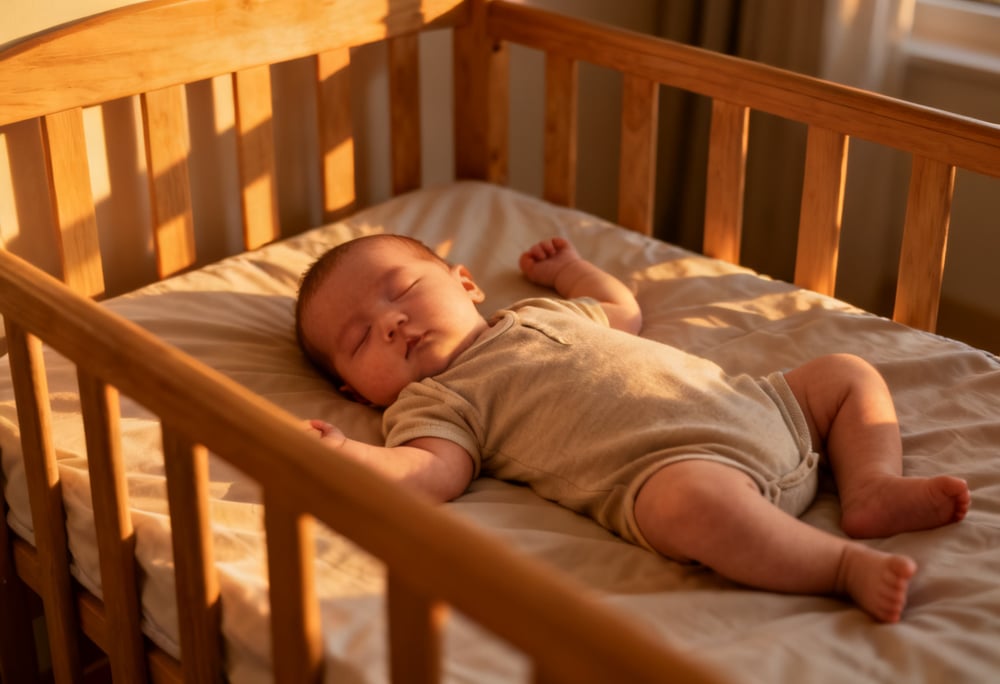
If you've been told that a newborn "sleeps like a baby," you probably expected something different. In the early weeks, your baby wakes every few hours, the nights break up, and it's easy to end up wondering if something is wrong.
It's one of the most common surprises of the newborn stage, and it's worth getting it straight early: a baby waking several times a night is part of their development, not a sign that you're doing something wrong. Feeling frustrated is normal; your baby not sleeping through the night doesn't mean their sleep is broken.
Why your baby's sleep doesn't work like yours
An adult cycles through roughly 90-minute sleep cycles, with long stretches of deep sleep. A newborn, on the other hand, sleeps in 50- to 60-minute stretches and spends much more time in active sleep — the phase that corresponds to REM sleep in adults. That predominance of active sleep at birth is part of normal maturation.
In practice, this means your baby spends more time than it seems transitioning between cycles. Some of those transitions are very brief wakings where they fall back asleep on their own, and others are wakings where they need company, food, or a diaper change. This repeats several times a night, especially in the first weeks.
According to the review published in Pediatric Research on sleep development during the first year, the pattern gradually consolidates: from about 4 months on, deep sleep starts to increase, naps become more regular, and cycles get longer. That maturation is gradual and varies a lot from one baby to the next, so comparing your baby's night with an older child's usually doesn't help.
How many night wakings are within the normal range
A longitudinal study of sleep behavior in healthy infants followed babies through the first months and recorded what to expect at each age.
- Between 1 and 2 months: close to 50% of babies wake only once or twice a night. The other half wakes more often.
- By 3 months: around 9% are still waking more than twice a night.
- By 6 months: that percentage is around 21%.
- By 9 months: it approaches 26%.
These figures cover healthy, well-fed babies. What matters isn't comparing with the neighbor's baby, but understanding that several wakings a night are still common at least through the first year, and on their own, they aren't a red flag.
Total sleep hours also depend on age
As HealthyChildren points out, the recommended hours are measured as 24-hour totals, adding nighttime sleep and naps: in a newborn they run in short stretches of 16 to 17 hours; between 4 and 12 months, 12 to 16; between 1 and 2 years, 11 to 14. If your baby takes long naps, it's normal for nighttime to be shorter — and vice versa.
Safe sleep: five non-negotiable conditions
The recommendations from the AAP and the safe sleep guide on HealthyChildren.org, the AAP's parent site, point in the same direction: in the early months, the priority isn't stretching out sleep, but sleeping safely. The AAP's 2022 update summarizes what counts, in this order.
- On their back, every time: for every sleep, nighttime or nap, until your baby can roll both ways on their own and roll back onto their back without help.
- Firm, flat surface: a firm mattress covered only by a fitted sheet. No extra padding, no soft toppers, no wedges.
- Empty crib: no pillows, blankets, stuffed animals, positioners, baby loungers, or padded bumpers. HealthyChildren's safe sleep guide puts it plainly: every soft item adds risk without adding benefit.
- Comfortable room temperature: keep the room in a comfortable range, without overheating. If you're unsure, skip the extra layers: a light layer and checking the back of the neck or chest is better than adding loose blankets.
- Smoke-free: a tobacco-free environment. Prenatal or postnatal exposure, even passive, is a well-documented risk factor.
These five conditions are the foundation. Any accessory that doesn't meet them — even if it promises more hours of sleep — falls into the territory of the next section.
Shared room, not shared bed
Where your baby sleeps makes a big difference day to day. The AAP recommends that your baby sleep in your room, close to the bed, but on a separate, infant-designed surface, ideally for at least the first six months. HealthyChildren's safe sleep guide points to the practical version of that advice: a crib, bassinet, portable crib, or play yard close to the parents' bed, with a firm surface and no soft padding, makes nighttime feeds easier without bringing the baby into the adult bed.
Bed-sharing is worth talking about without preaching and without minimizing. The general safe sleep recommendation is a shared room, not a shared bed. On top of that, HealthyChildren's safe sleep guide stresses that sharing a bed with your baby increases the risk when there's extreme tiredness, alcohol, sedatives, or soft surfaces in play. There's one especially dangerous scenario worth keeping in mind: falling asleep with your baby on a sofa or armchair, even just for a quick nap.
- If you do end up sharing a bed at any point, it's worth lowering the risks: no soft mattresses, heavy comforters, large pillows, or adults under the influence of alcohol, sedating medication, or extreme drowsiness.
- If you're on the fence: a crib, bassinet, or portable crib close to the bed shortens the physical distance without sharing a surface. It's the middle ground with the most consensus.
- For families with premature or low-birth-weight babies, the recommendations are stricter and worth reviewing with the pediatric team that follows you.
Bouncers, cushions, and other products to keep out of the crib
Some products are marketed as sleep aids, but they don't meet the basics of safe sleep. These are the ones worth keeping out of the crib.
- Bouncers, rockers, and swings: they're useful when your baby is awake and supervised, but they're not a safe place to sleep. If you're weighing options at home, choose whatever setup fits your space and your routine — just keep them out of the nighttime routine.
- Anti-roll cushions and positioners: the AAP explicitly advises against them; they don't prevent SIDS and can trap the baby if they roll.
- Baby loungers and wedges: they add soft padding around the baby. An empty crib is the only firm recommendation.
- Pillows: not before age 2, and only when your child sleeps with the posture and movement of a small adult.
- Blankets, comforters, and heavy sleep sacks: a sleep sack sized for the season is better. If it's cold, add a layer of clothing; never use a loose blanket in the crib.
The practical rule: if an accessory is soft, squishy, or holds the baby in a fixed position, it shouldn't be in the crib. The promise of more rest isn't worth the added risk.
Routine, naps, and feeding wakings: what to expect day to day
Beyond a safe sleep environment, there are some gentle habits that can help structure the day — without promising miracles.
- Naps count: if your baby takes two or three long naps, it's normal for nighttime to be shorter. Counting sleep over 24 hours takes the pressure off the nighttime hours.
- Wakings to eat are normal: in the first weeks, especially with on-demand nursing, your baby needs frequent feeds overnight. Mayo Clinic notes this as part of the expected pattern, not a problem to fix.
- Routine, not magic ritual: a short, repeatable sequence at the start of a nap or nighttime — dim light, soft sound, calm presence — works as a predictable cue. It doesn't shorten sleep on its own, but it reduces the time it takes to fall asleep.
- Babies learn day from night: natural light during the day, a dim environment at night, everyday household sounds without aiming for total silence. That contrast helps your baby's internal clock.
If a routine works for your family, keep it. If not, no big deal: the habits matter more than the exact order, and changing a sequence rarely fixes a rough night on its own.
What about the cry-it-out methods
For years, methods like Ferber or other graduated-extinction approaches have been popular. They work by spacing out the response to crying with controlled intervals, to try to get the baby to fall asleep without direct help. It's not the same as ignoring any crying, but it's worth putting it in context: they shouldn't be used with newborns, they don't work for every family, and they don't replace responding to hunger, pain, fever, discomfort, or a need for closeness.
In very young babies, sleep still depends a lot on maturation, feeds, and the safety of the environment. So before thinking about "sleep training", it makes more sense to review the basics: your baby's age, feeding, expected wakings, where they sleep, and signs that might mean it's worth checking in with your pediatrician.
Myths worth leaving behind and when to check in with your pediatrician
Six myths to leave behind
- "If they wake up, we're doing something wrong": false. Frequent wakings are normal in the early months.
- "By six months they should sleep through the night": false. Many healthy babies still wake at night at that age.
- "The more tired they are, the better they'll sleep": false. Overtiredness usually brings more irritability and a harder time falling asleep.
- "A bouncer works as a bed": false. It's an inclined surface and doesn't replace a crib or bassinet.
- "An anti-roll cushion adds safety": false. Soft accessories around the baby add risk.
- "You have to let them cry so they learn to sleep": not necessarily. Some methods use controlled intervals, but they aren't a universal rule and don't fit newborns.
When it's worth checking in with your pediatrician
Beyond wakings, it's worth making an appointment if you notice any of these signs, whether one-off or ongoing:
- Regular snoring: noisy breathing on a regular basis, not just when they have a cold.
- Breathing pauses: breathing stops, restarts with a gasp, or becomes very shallow.
- Gasping or bluish color around the mouth or on the lips during sleep.
- Unusual daytime sleepiness: hard to wake or unusually flat during active hours, even when they sleep a lot at night.
- Difficulty gaining weight or feeds that are too short and too frequent without your baby swallowing well.
HealthyChildren covers these signs in their guide on infant sleep apnea, and Mayo Clinic emphasizes that effective infant sleep isn't only measured in hours: the quality of breathing and ease of waking matter as much as the total count.
If you've read this far with the feeling that your baby isn't sleeping through the night but is breathing well, eating, and gaining weight, the most likely thing is that you're living through a hard and normal stage at the same time. The phases pass; the safety stays.

Written by
Marta RuizMaternity and parenting specialist
Creates practical content about pregnancy, postpartum and early months.
You may also like
More helpful reads for common questions at this stage.
View more
Aug 14, 2026
Sensory stimulation and psychomotor development in babies: an age-by-age guide
What sensory stimulation and psychomotor development mean, how they support your baby’s development and which simple activities you can offer from 0 to 12 months without rushing them.

Apr 14, 2026
First 7 Days at Home with Your Baby: What to Prepare Before Leaving the Hospital
Have ready what you really use after coming home from the hospital: sleep, diaper changes, feeds, clothes, and essentials without filling the house with extras.

Jul 24, 2026
Premature babies: care, corrected age and coming home
What it means when a baby is born prematurely, what happens in the neonatal unit, how corrected age works and what to prepare before bringing your baby home.

Mar 16, 2026
Baby Shopping by Trimester: What to Sort Early and What Is Not Worth Rushing
Organize baby purchases around real stages: what to look at early on, what to lock in with time to spare, and what to leave until later so you get there with less rush and less impulse spending.