















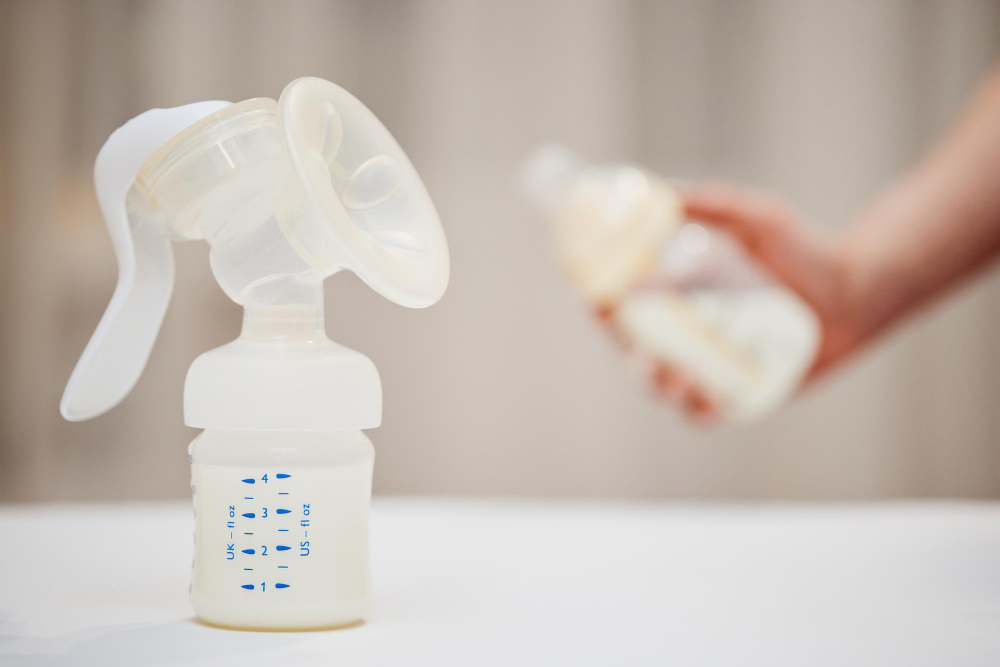
When you start looking at breast pumps, words like manual, electric, single, double, hands-free and wearable keep coming up. The snag is that they don't all describe the same thing: some describe how the suction is generated, others describe whether you express from one breast or both at once, and others describe how the pump is worn. So it helps to understand each term on its own before you start comparing models.
The three basic parts of a breast pump
Every breast pump combines three basic elements:
- Flange: the funnel-shaped piece that sits against the breast and creates the seal.
- Pump: the mechanism that creates the suction. It can be hand-operated or motor-driven.
- Container: where the milk collects. It can be a bottle, a storage bag, a cup or a reservoir built into the pump itself.
Designs vary between models, but they all cover those three basic functions.
Manual or electric: how the suction is generated
The first big difference between breast pumps is how the suction is generated. It doesn't depend on whether the pump is double or wearable, and it doesn't depend on the brand: it depends on whether there is a motor.
Manual breast pump
With a manual breast pump, suction is generated by squeezing a lever, a handle or a bulb. There is no motor, no battery and no mains connection, and you control the rhythm directly as you express. The trade-off is that you have to keep squeezing for the whole session.
Electric breast pump
A motor creates the suction cycles automatically. Many models let you adjust the intensity, and some also let you change the rhythm or the suction pattern. The pump does the work for you, although depending on the format you may still need to hold the flange in place or use a pumping bra.
A practical rule of thumb is to start at the lowest intensity you can and build up gradually to a level that feels comfortable, without forcing or causing pain. Most models offer several levels so you can find that point.
A silicone milk catcher is not the same as a manual breast pump
Silicone milk catchers attach to the breast and stay in place thanks to the suction created when you squeeze them. They mainly collect the milk that flows, for example while your baby feeds from the other breast.
They have no handle and no motor, and they do not create suction cycles in the same way as a breast pump. Their purpose is different from a classic manual pump: closer to catching let-down or taking the edge off a one-off bout of fullness than to running a full expressing session.
Understanding this stops you from choosing a catcher expecting it to do the job of a manual pump. A catcher isn't a substitute for an active expression pump.
Single or double: one breast or both at once
Single breast pump
It expresses milk from one breast at a time. Compared with the double version of the same system, it usually uses fewer parts, takes up less space and is quicker to clean. It can be enough if you only want to express from one breast at a time, but it means switching sides if you want to keep going on the other.
Double breast pump
It expresses milk from both breasts at once. It's useful when you want to shorten the overall session. The trade-off is usually more parts, more careful assembly and more time spent cleaning.
Traditional, hands-free and wearable: how the pump is worn
Another separate layer is how the pump sits against your body.
Traditional format
In the traditional format, the flange and the container sit outside your bra. On electric models, the motor may be attached to the assembly or connected by tubing.
Hands-free
A hands-free system holds the flanges or cups in place without you needing to support them. It may use a pumping bra, cups inside your bra or a design with the motor built in. So hands-free doesn't necessarily mean wearable.
Wearable or in-bra
In a wearable pump, the motor, the cup and the container form a single unit that fits inside your bra. There are no tubes and no external pump, and it can be sold as a single unit or as a pair for double expressing. Every wearable pump is hands-free, but not every hands-free system is wearable.
What else is worth checking beyond the type
Other practical details worth bearing in mind when you're choosing:
- Flange size: your nipple should sit centred and move freely through the tunnel, without rubbing or pulling in too much tissue.
- Intensity and rhythm control: which settings you can choose and how easy they are to adjust mid-session.
- Parts to clean: the fewer parts that touch the milk, the easier everyday washing becomes.
- Battery and runtime: if you plan to use it away from a mains socket, battery life and charging time matter.
- Container capacity and compatibility: how much it holds, how easy the markings are to read and whether you can use the bottles or bags you already own.
What to compare before you choose yours
When you're looking at a specific model, these questions make it quick to see how it works and how it stacks up against others.
- Is it manual or electric? If it's electric, does it run from the mains, on batteries or on a rechargeable battery?
- Does it express one breast or both at once?
- Is the format traditional, hands-free or wearable?
- How many intensity levels and rhythm patterns does it offer?
- Which parts touch the milk and how many parts are there in total?
- How heavy is each unit (especially if it's wearable)?
- What battery runtime does the maker claim and how long does it take to charge?
- What flange size is included and which other sizes can you buy?
- Does the maker identify itself clearly, are the instructions easy to follow, and is there a warranty, spare parts and after-sales support?

Written by
Marta RuizMaternity and parenting specialist
Creates practical content about pregnancy, postpartum and early months.
You may also like
More helpful reads for common questions at this stage.
View more
Jul 15, 2026
When you feel awkward about sharing your baby registry
Sharing your baby registry can feel a bit awkward. I'll show you how to send it without it sounding like a demand, and I'll give you two messages you can copy.

Aug 20, 2026
First-time parents: what to do in the first few weeks with your baby
A practical, reassuring guide to feeding, everyday care, safety and the signs that call for professional help.

Mar 02, 2026
Baby Registry in One Hour: What to Add First and What to Remove Without Worry
A quick way to build a useful registry by priority, without adding gifts that later get in the way or leaving out what is worth planning for.

Aug 14, 2026
Sensory stimulation and psychomotor development in babies: an age-by-age guide
What sensory stimulation and psychomotor development mean, how they support your baby’s development and which simple activities you can offer from 0 to 12 months without rushing them.